Pages

Showing posts with label literacy. Show all posts

Monday, January 4, 2016

I had the privilege of attending a training with the brilliant Lucy Calkins this winter. Of course I left the day long session with a lot of notes and ideas, but I wanted to share this particular set of questions because they are all simple yet very profound. Here is the list that has already helped me to be a better teacher of reading and thinking. I hope you experience the same thing!

Questions to push thinking about CHARACTER…

  • How are the character names significant?
  • How are the characters changing or staying the same over time?
  • What or who causes the character to most be themselves?
  • How do the characters react to the setting?
  • What are the relationships between the characters like?
  • Who do these characters remind you of and why?
  • What details about the characters has the author left out?


Questions to push thinking about SETTING…
  • What tone does the setting create?
  • If the story was set somewhere else, how might it be different?
  • What does the setting allow for?
  • What does the setting limit?
  • Does this setting remind you of somewhere you’ve been?
  • What details has the author kept from us about the setting?


Questions to push thinking about PLOT…
  • What patterns are showing up?
  • How do the current events add to the problem or the solution?
  • Is there any hint of what’s to come (foreshadowing)?
  • How is the passage of time represented?
  • What is moving the story forward?
  • How is the structure related to the plot?
  • What perspectives are represented?
  • What perspectives are missing from the story?


Ways to write longer…
  • I wonder if this…
  • More evidence of this is…
  • The author could have __________ but instead they…
  • If nothing changes, this might lead to…
  • This adds to my theory about…
  • This supports or conflicts with the title because…
  • I disagree with the author’s choice to…
  • As I read, I’m changing how I think about…

Wednesday, April 15, 2015

An Up-Close Look at the Classroom Library

I know I've posted on this before, but I've had some questions. So here is the illustrated tour of my second grade classroom library:
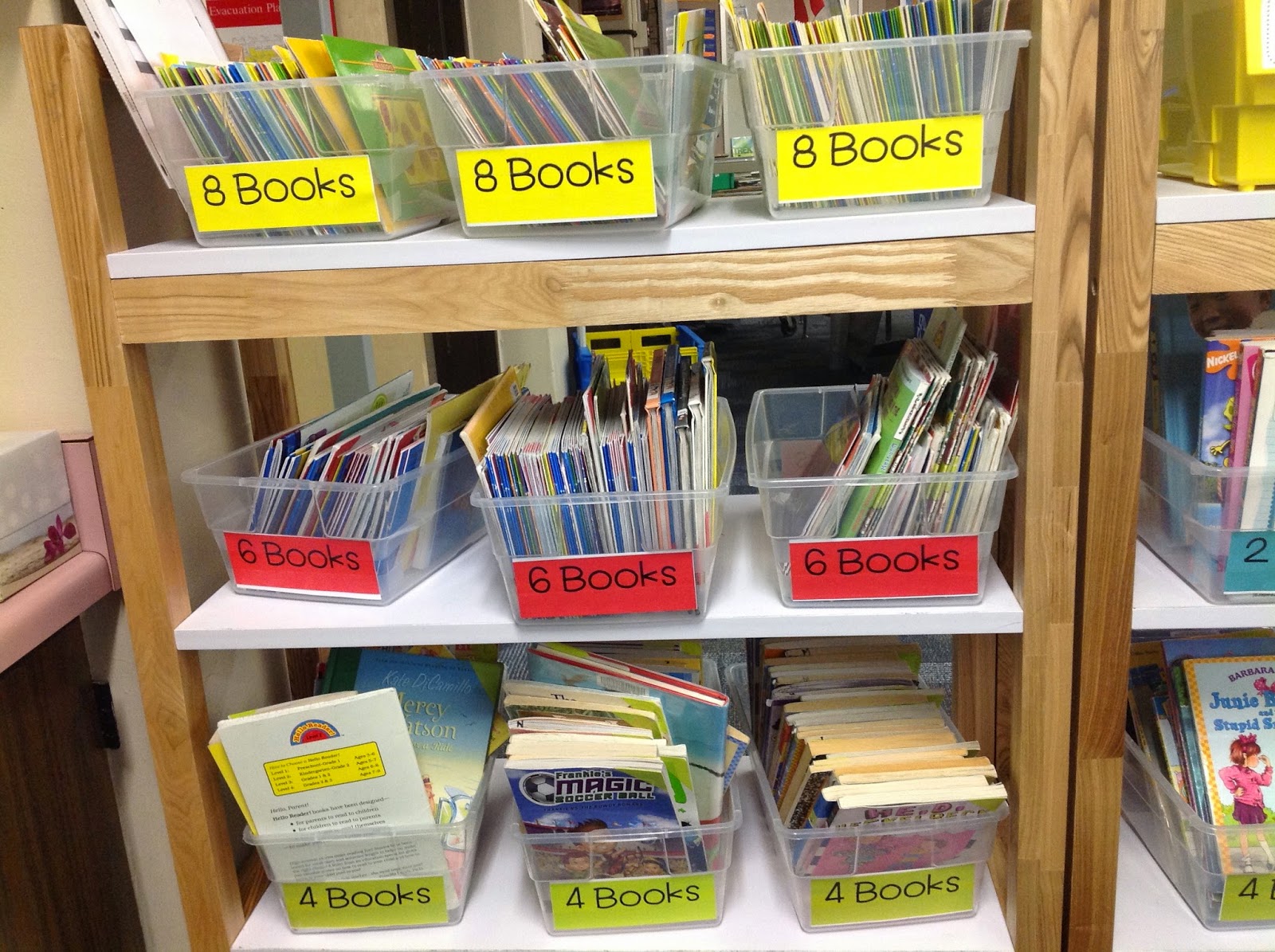
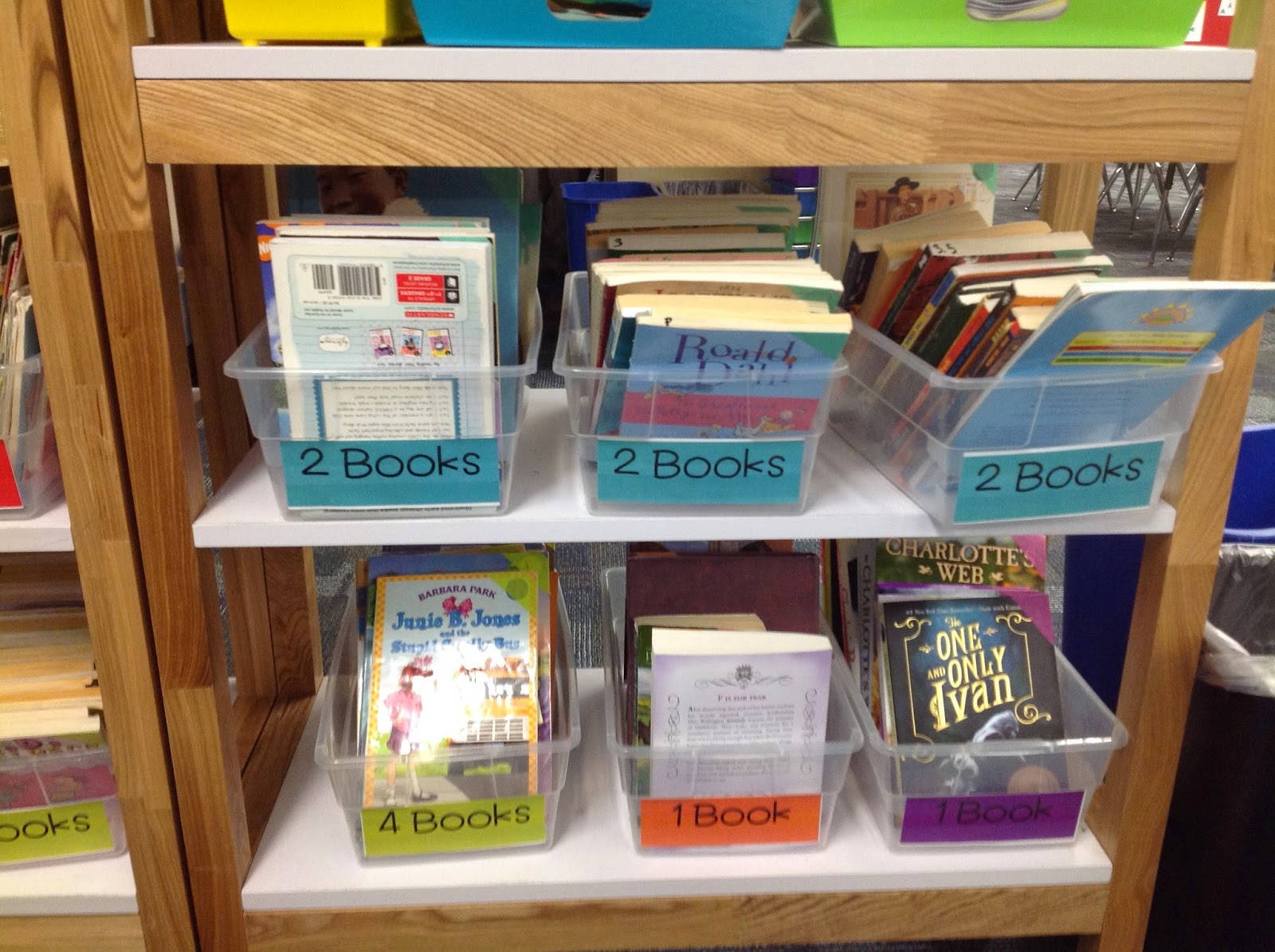
First off, the leveled book section...If you want to know more about the levels, how they correlate with F & P or DRA, see this post from the summer. Basically the important things to point out here is that the shelves were $20 each from Goodwill and the plastic bin were $5 for 6 at target. Well, thats not THE important thing....but its one of them :) The numbers on the outside are there to remind the students of how many of the level they should have in their book box at a time. They find out what bins they should take from in reading conferences with me. If you are familiar with levels of reading you know that the very beginning books are extremely short and students usually need 8-10 to keep busy reading. This is why they take a minimum of 8 books from yellow. I know there is discussion from teachers about how many chapter books should really be reading at the same time and so some of you might disagree with 4 lime green books or even 2 teal books in a book box at once. My thinking about that is this; at this very moment, I have 3 books on my nightstand and 2 in my purse. I am reading only 2 of them and the rest are lined up waiting for "their turn"....my students deserve to do the same!
 
You can see in the photos below that the books are not letter or number labeled...I gave that up when I switched my library organization up. Instead, I used colored masking tape on the corners to indicate the level and help with quick organization. Once again, if you want to know more about the color levels, see this post.

As far as the other books go (which I refer to choice books) here are the details:
  • I have them separated into literature text (animal characters, poetry, realistic fiction, etc) and informational texts (biographies, magazines, science, jobs, etc.) 
  • The books are each labeled in the top corner of the front corner of the cover and the informational text have a start sticker. This is how we tell informational apart from literature. 
  • I have the informational book bins on a counter and the literature text on some shelving that wraps around the room. 
  • Most students have just one of each kind at a time, sometimes more. 
  • The bins themselves are from IKEA and I have found them to be awesome storage for large books like these...


I really like this organization and for sure have had less issues with organization and book treatment this year. Taking the time to label and look for just the right bins was a pain, but I am so glad I did!


Thursday, February 12, 2015

Practical writing instruction

One of the things I hear most often from teachers is about the struggle to find time for everything and make it all "fit together." I realize this can be difficult when special events and timed-to-the-minute daily schedules are the the norm, but I see it a little differently. One of the things I have committed to doing with my students a lot is low-risk-high-interest writing. And I am continually surprised by how often we can "fit it in." 

 For example, during our social studies unit on Citizenship, we studied many different current and historical figures that are examples of compassion, curiosity, commitment and community involvement. My students collected information about them in whatever way they would like in some research packets I created. The information was to be organized into those four C categories I just listed... but it didn't matter to me if they drew with labels, wrote full sentences, made a flow map of events or recorded important dates...just as long as it made sense to them.
After all the note-taking, it seemed like they still had a connection to these people, and in some cases lingering questions. Enter----letter writing opportunity! I took one day to show, study and explain a few letters (including the format of the one from MLK to JFK from the previous post) before sending them off to write one of their own. They were able to choose which person to write to and had only the following expectations;
  • Follow the letter format (greeting, body, salutation)
  • Identify one of the four Cs that the "Great Citizen" showed and the evidence
  • Ask one question
  • Thank them for their example
The results were wonderful as you can see, they really loved the chance to channel what they learned and write with purpose about something they had studied and cared deeply about. And the best part is, I thought of it in the car on the way to school, took 20 minutes to teach them how and 45 minutes to let them work...we got a lot out of that hour and 5 minute learning experience :)


Using primary source documents in primary grades

During my time at the Teacher's College Reading and Writing Project Institute last winter, I was reminded of the importance of sharing real pieces of history with our youngest learners. As we practiced deep thinking and literacy practice with primary source documents at the institute, I began to image what I could do in my classroom.
This winter, as my students began studying great citizens and we dove head first into content are literacy centers, I was delighted to go back to the Library of Congress website to retrieve a couple great pieces to share with them. If you haven't visited their site, you should! There is a classroom materials section and collections of primary source documents by theme.
Since most of great citizen study began with Martin Luther King Jr. I was immediately drawn to a letter that he wrote to JFK, just after he was inaugurated. It became the focal point of my "Write Around Center" and I was not disappointed by the engagement and conversations it sparked!

Saturday, July 26, 2014

Summer Learning Academy

As a way of getting my feet wet back in the classroom, and warming up to teach 2nd grade this fall...I am spending 5 weeks teaching summer school. It's so interesting to me to hear the reactions of non-teacher adults to summer school. They wonder if the kids view it as punishment or if they want to be there...they wonder if its different from regular school instruction and if it makes a difference. Good questions, logical questions mostly. This year, I have the privilege of working with a group of 23 second graders who actually seem to like coming, and are pretty realistic about what they want to work on. The half day schedule works for me and them...and certainly makes us work harder all morning long.
In the past when I've taught, I always felt scattered and overwhelmed with where to start and how to plan, so I took it upon myself to simplify what I would cover as a result of the pre-assessment. We are 3 weeks in and still in schedule so it seems to be working :)


Monday, July 14th
Tuesday, July 15th
Wednesday, July 16th
Thursday, July 17th
*I can ask and answer questions to demonstrate I understand key details in an informational text
*I can use strategies to generate addition and subtraction facts
*I can ask and answer questions to demonstrate I understand key details in an informational text
*I can use strategies to generate addition and subtraction facts
* I can use mental strategies to add and subtract two-digit numbers
*I can ask and answer questions to demonstrate I understand key details in an informational text
* I can use mental strategies to add and subtract two-digit numbers
* I can solve real-world and mathematical addition and subtraction problems with 2 digit numbers
*I can ask and answer questions to demonstrate I understand key details in an informational text
* I can solve real-world and mathematical addition and subtraction problems with 2 digit numbers
Monday, July 21st
Tuesday, July 22nd
Wednesday, July 23rd
Thursday, July 24th
* I can describe the connection between events, ideas, concepts, or steps in an informational text
* I can solve real-world and mathematical addition and subtraction problems with 2 digit numbers
* I can use addition and subtraction to create and gather information from tables, bar graphs and tally charts
* I can describe the connection between events, ideas, concepts, or steps in an informational text
* I can use addition and subtraction to create and gather information from tables, bar graphs and tally charts
* I can describe the connection between events, ideas, concepts, or steps in an informational text
* I can use addition and subtraction to create and gather information from tables, bar graphs and tally charts
* I can describe the connection between events, ideas, concepts, or steps in an informational text
* I can use addition and subtraction to create and gather information from tables, bar graphs and tally charts
Monday, July 28th
Tuesday, July 29th
Wednesday, July 30th
Thursday, July 31st
* I can retell stories I have read
* I can identify the overall structure of a story
* I can find the value of a group of coins.
*I can tell time to the hour, half hour and quarter-hour.
* I can retell stories I have read
* I can identify the central message, lesson or moral of a story
* I can find the value of a group of coins.
*I can tell time to the hour, half hour and quarter-hour.
* I can retell stories I have read
* I can identify the central message, lesson or moral of a story
* I can find the value of a group of coins.
*I can tell time to the hour, half hour and quarter-hour.
* I can identify the central message, lesson or moral of a story
* I can find the value of a group of coins.
*I can tell time to the hour, half hour and quarter-hour.
Monday, August 4th
Tuesday, August 5th
Wednesday, August 6th
Thursday, August 7th
* I can identify differences in points of view of characters
* I can use a ruler to measure lengths to the nearest centimeter or inch.
* I can identify differences in points of view of characters
* I can describe how characters in a story respond to major events and challenges.
* I can use a ruler to measure lengths to the nearest centimeter or inch.
* I can describe how characters in a story respond to major events and challenges.
* I can ask and answer questions to demonstrate I understand key details in literature.
* I can use a ruler to measure lengths to the nearest centimeter or inch.
* I can ask and answer questions to demonstrate I understand key details in literature.
* I can use a ruler to measure lengths to the nearest centimeter or inch.
 The learning targets in blue are for literacy and the red are for math. It was so interesting to see how well their needs panned out for the 5 week plan. I post the learning targets weekly and it provides an anchor for the students and myself. You'd be amazed to hear how often they are asking the main idea question from week one "What is this text mostly about?" Its pretty cute :)

If I teach summer school again I will definitely use this method of planning and posting the learning targets we are working on. By the end of our program I believe the kids will have accomplished some very realistic goals and I will be able to measure their progress very specifically.

Here's to summer school! To those that attend and those that teach... Its a very different little world in here, isn't it? :)

Thursday, May 22, 2014

Classroom Library Organization Begins....

So, I'm going back to the classroom next year. I'll be teaching 2nd grade for the first time and I'll be on a new team in a new school. Lots of new, I'm really excited! I like change. One of the first things that popped into my mind when I began imagining things I wanted to do differently than I used to was my classroom library. I left a good chunk of my beloved library behind (because it had been purchased with school money) but I own a great deal of books too. As a first grade teacher, I had most of the books organized by Guided Reading level, and then some genre tubs. I don't have pictures, but it was kind of like this.

Anyway, as I have grown in my understanding and read a lot about such things, and I have changed my opinion on how this should be done. There a several factors I want to take into consideration when organizing the library and setting expectations for classroom book selection;
In the end, this is where I have landed...
If you check this post, you will see some of the work I did to start wrapping my brain around pulling the guided reading levels and CCSS text complexity bands together. After that work was done I decided that I wanted to reflect those bands in my library organization without over emphasizing the high, medium or "lowness" of them...does that make sense? I basically didn't want to just number them 1, 2, 3. So I settled on colors, specifically colored masking tape, for organization. 
There is my copy of the chart, which I just added the tape colors to. This isn't very profound, I know. Basically its separated by grade level ,but its not cut and dry (especially if you look closely at F&P guided reading levels.) The picture doesn't show this well but the first color is yellow and the 3rd one is lime green! I chose the tape for a few reasons, its bright, I can easily get more, and it allows me to cover the previous circle stickers with letters on them, by wrapping it around the corners like so:
These are new books ( rom the Scholastic Warehouse Sale!) so they didn't have the circle stickers in the top right corner, but the other 200 books I have in storage do :( Once again, I am trying to get away from kids or myself saying "Your'e reading level D books." With this new color coding system I will be able to direct my kiddos to a color  they should be reading within (based on assessment data) but then also work with them to build their capacity to independently choose "just right books."  In other words, I'm trying to honor and understand these words from CCSS Appendix A:
So once I figure out storage of the "ranges" of texts ( I'm thinking maybe these......because then I can put them on the floor around the edge of the room or on top of other shelving?) students will be choosing books for their book boxes from the color they have been assigned, but  growing in their understanding that even within the red bins, some books are going to be hard, some are going to be easy, and some will be just right. 

I'll post pictures once I get in there and get things set up. I'm excited about this new way of thinking and the possibilities for my new 2nd grade readers!

Thursday, May 1, 2014

Content Area Centers...with an elementary twist!

While at Teachers College back in February, I learned about content area centers for middle schoolers and fell in love with the idea. For those of you who have been teaching primary grades, centers are not new for you. But when my learning happened the examples I was provided all had to do with middle school and to be honest, the task cards were a bit overwhelming, so I starting thinking through how I would tweak them for elementary, and here is the resulting post :) 

 What if instead of cracking open social studies textbooks or jumping into science experiments from our FOSS or EIE kits, we had a day or two set aside for centers? K-8 teachers, I want to challenge you to think about some of these compelling reasons to engage in this type of teaching for the purpose of increasing your student's learning. 
Centers are: An opportunity for students to engage with content in a variety of the ways, many "access points", Requires deep thinking about content, rather than "sit and get, Students learn from conversation with one another, defending opinions, justifying thinking  with text evidence, Allows for differentiation in task, support, and thinking, Great chance to generate and answer "big questions", Lends to  thoughtful CCSS connections, Builds independence and ownership of learning, Here are some ideas for centers that could become part of your instruction regardless of the center;
Of course students need to know what your expectations are for the centers, and that does take time. Once students know what the expectations are for the photograph center however it doesn't matter if the photos are of the civil rights movement, science content, or even a math diagram, they know what to do.